Bagi rekan-rekan yang berencana jalan-jalan ke Jepang, coba deh luangkan waktu untuk mampir ke Odaiba (daerah pinggir pantai Tokyo). Di sana banyak sekali terdapat objek wisata menarik seperti ‘Rainbow Bridge’ (jembatan pelangi), patung Liberty (tiruan) dan stasiun televisi Fuji.
Pemandangan akan sangat indah ketika hari mulai menjelang malam. Kerlip lampu kendaraan dan iluminasi lampu Jembatan Pelangi (Rainbow Bridge) semakin menambah semaraknya kota Tokyo di malam hari.
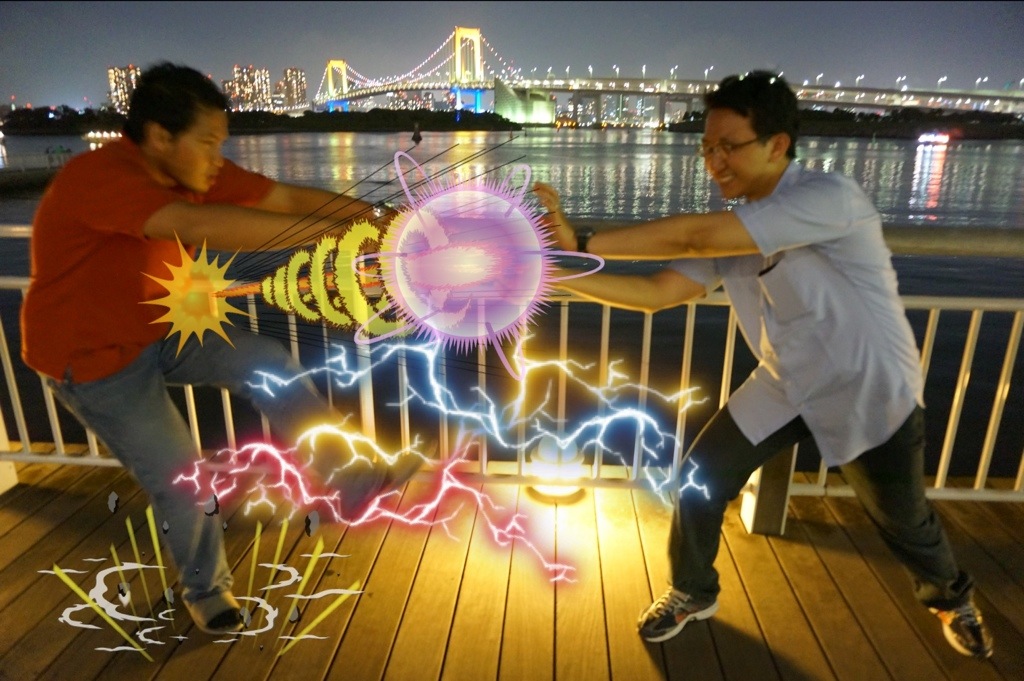
Sembari asik menikmati pemandangan malam di Odaiba, kami pun menyempatkan diri untuk belajar Kamehame di pelataran dekat jembatan Odaiba: (hehe…)
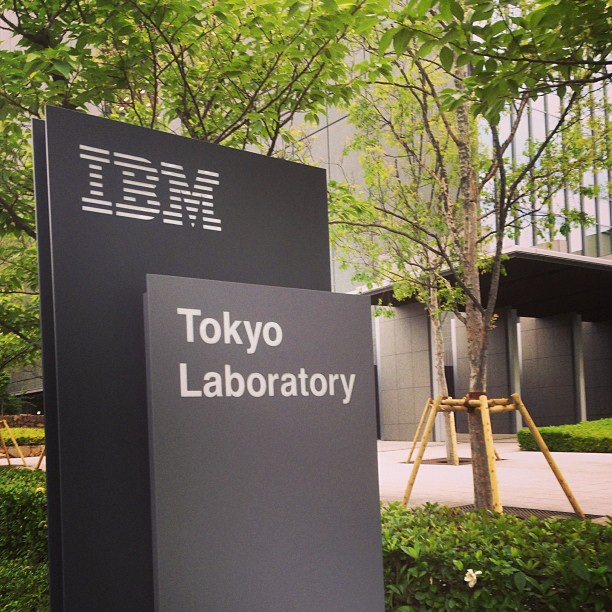
Setelah sekitar tiga bulan training di kantor pusat (Tokyo) dan kantor di Chiba, akhirnya saya diberikan kesempatan untuk OJT (on job training) di daerah Toyosu, IBM Tokyo Laboratory.
Hari ini kami pergi tamasya ke Tokyo Tower sembari menikmati hangatnya udara musim panas di Jepang. Sebelum pergi, kami sarapan Tempura soba dulu di restoran dekat rumah:
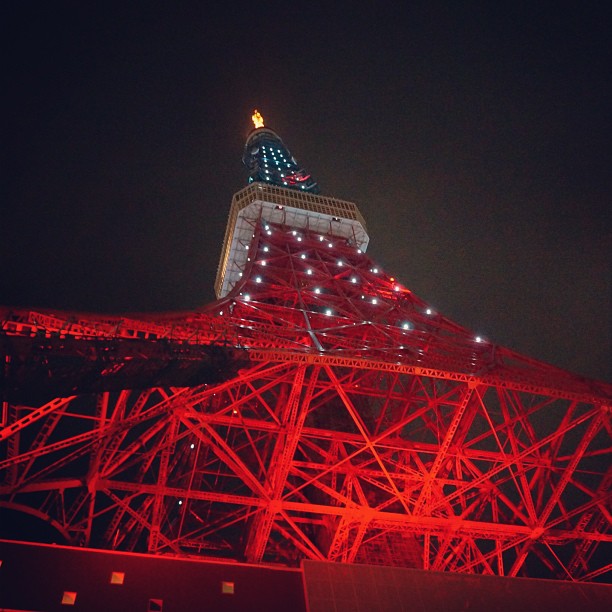
Sesampainya kami di Tokyo Tower, kami coba mengabadikan beberapa gambar yang cukup bagus dari Tokyo Tower:
Tiket masuk Tokyo Tower:
Tokyo Tower ketika malam:
Video yang kami ambil dari atas Tokyo Tower pada siang dan malam hari:
Master Thesis Defense: Date: February 21st, 2011 Time: 14:55 – 15:55
Place:
Media Room, Department of Computer Science, Gunma University Kiryu Campus
*This paper has been accepted for publication in the Asian Conference on Pattern Recognition 2013 (in conjunction with IAPR–International Association of Pattern Recognition).
Thesis: Pdf file will be available soon
Title:
“Performance Evaluation of Feature Descriptors for Application in
Outdoor-scene Visual Navigation”
Abstract: During the past decades, scientists
have made numerous efforts in developing autonomous mobile robots.
One of the popular method to be applied for visual navigation is
scene matching algorithm. The idea is to localize the robot
position by finding out matching between the input running scenes
and a set of reference images. However, to achieve an appropriate
matching between the compared images is not an easy task. A
frequent change in the illumination intensity is one of the biggest
challenge during the experiment of scene matching. Unfortunately,
there is no quantitative evaluation of feature matching
performance, especially focusing in the problem of illumination
changes. This thesis presents an investigation of a number of
popular feature detectors and descriptors in matching the outdoor
environment and observe the performance in three different lighting
scenes, i.e., sunny, cloudy daytime, and cloudy evening, captured
within the same route by the autonomous mobile robot. To give an
equality comparison, we applied the Lowe’s matching procedure
[Low04] for all compared methods. The matching percentage and ROC
curve are used for the evaluation measurements. As for the
experimental results, the hybrid performance of FAST detector and
SURF descriptor gives the best evaluation measurement by showing
the largest value of area under ROC curve. In addition, FAST, and
SURF show advantages on their speed in extracting local image
features which is favorable for real time application. On the other
hand, SIFT achieves its stability in nearly all situations. ASIFT
presents the highest number of extracted keypoints although it
suffers from the problem of computation complexity and redundant
matches. Video
Bachelor Thesis Presentation:
Date: February 23rd, 2011
Time: 13:00 – 15:00. 7 sessions. (10 minutes presentation & 5 minutes discussion)
Place: Media Room, Department of Computer Science, Gunma University Kiryu Campus
Thesis: Dzulfahmi_Bachelor_Thesis.pdf(in Japanese) Title:
“Polygon recognition algorithm for the purpose of image pattern matching and its application to autonomous mobile robot”
『図形パターン照合 のための多角形認識アルゴリズムとその自律走行ロボットへの応用』
Abstract:
The problem of detecting and recognizing polygon shapes in images becomes one of important research topics in the field of image processing. In this paper, we present an effective approach to recognize polygon shapes based on object contour approximation. Its application is then deployed into our participation in The Tsukuba Challenge autonomous mobile robot competition. Experimental results indicate that the proposed technique shows promising achievement on recognizing a unique (triangle) shape on the automatic door near the Goal area.
【概要】
画像認識の様々な状況で必要とされる図形パターンの照合を行うため、本研究では多角形の認識を用いたアルゴリズムを考案し、実験 した。このアルゴリズムでは、画像内にある物体の輪郭と認識目的の形状との類似度を計算することによって図形を認識する。このアルゴリズ ムを自律型走行ロボット大会「つくばチャレンジ」のロボットの環境認識に適用して例を述べる。このアルゴリズムによってゴール付近の自動 ドアにある特徴的な形状(三角形)を認識し、ロボットをゴールへと誘導する。
Special thanks for Stefan Schaeckeler who shared a very nice article about the LaTex template for Master or Ph.D Thesis. Please visit his page for detail information: http://students.engr.scu.edu/~sschaeck/latexforthesis/
The content of the template is explained below ( I just copy and past Stefan’s web page).
The template includes a Makefile that creates three files:
thesis.dvi for fast previewing with hyperlinks in b/w
thesis.ps for printing in b/w (without any hyperlinks)
thesis.pdf for online viewing with hyperlinks in color
Organization of the Template
Makefile governs the compiliation; target: dvi, ps and pdf
thesis.tex holds everything together and includes
titlepage.tex
abstract.tex
acknowledge.tex
body.tex
thesis-man.ist for custom formatting of index (letter heading, dots)
references.bib for the bibtex bibliography
Features
the dvi and pdf files are fully hyperlinked
table of contents to chapters in the text
list of figures to figures in the text
list of tables to tables in the text
text to floats (figures and tables)
text to bibliograpy
bibliograpy to page in the text (not dvi version)
index to page in the text
glossary to page in the text
acrobat general information (pdf version, only)
thesis title
thesis subject
thesis author
thesis keyword
acrobat reader features (pdf version, only)
preview images are included
bookmarks: the bookmark includes not only links to numbered chapters, but also to unnumbered chapters (title, table of contents, list of figures, list of tables, acknowledgement, abstract, bibliograpy, index and glossary)
small pdf file size
Anti-Features
I changed (but not necessarily improved) the standard latex layout by using bars over chapter titles etc. This can be easily undone by deleting thesis.cls and changing in thesis.tex style thesis to style report.
Required Software
a flavor of unix for the makefile may be helpful
latex and pdflatex
non-standard packages: glossary.sty may need to be installed on teTeX, but comes with TexLive
make
ghostscript (thumbpdf)
optional: zip and ps2ascii
Bugs
2, 3 mm less top-margin on the index page (I recommend not creating an index page, anway. that is too much work)
before compiling dvi, ps or pdf, sometimes a make clean may be necessary
Contact
You are welcome to send me comments – Stefan Schaeckeler <sschaeck (at) engr.scu.edu>.
MATLAB 2012a Student Version
Simulink
Add-on products that extend MATLAB and Simulink:
– Control System Toolbox
– Image Processing Toolbox
– Optimization Toolbox
– DSP System Toolbox
– Signal Processing Toolbox
– Simulink Control Design
– Statistics Toolbox
– Symbolic Math Toolbox
Additional purchase for Computer Vision System Toolbox.
I recommend this toolbox to ease your work on Computer Vision! Sample source code: Detect SURF Interest Points in a Grayscale Image
%Detect interest points in a grayscale, image and mark their locations.
I = imread('c:/images/cameraman.tif');
points = detectSURFFeatures(I);
imshow(I); hold on;
plot(points.selectStrongest(10));



 Catatan Fahmi
Recent Comments